 Back in the hotel I made full use of the shower and free internet until dinnertime – including finding out about the sad death of Steve Irwin. People as driven and as passionate about wildlife as this man are pitifully few in this day and age. He may have been a complete Aussie nutcase, but he was a complete Aussie nutcase who cared about our world and the creatures we share it with. I suppose one small comfort is the stereotypical view that he went in a way he’d like to go – doing something dangerous, not sat on his backside at home.
Perhaps in some small tribute to this man, about seven people boarded a boat at the harbour and were taken to a smaller island called Ulva, where they would meet an animal that has been brought back from the brink of extinction by the hard work of people like Mr Irwin. Not a dangerous bird – far from it – but just as valuable and worthwhile a cause as any of the snakes, crocs or insects that he used to specialise in.
Ulva itself is a comparitively small island and used to be used for the postal service of the surrounding area up until the 1950’s. The entire island bar one small section is now in government hands, the odd bit being a holiday home. We were arriving after dusk as the Kakapo is a nocturnal bird so I was unable to appreciate the island as much as I’d have liked. One of the guys who was on the trip – Derek from Essex – had been over during the day and had a great time. Maybe on my next visit!
As an added bonus, we found out on the way over that Siroccos’s keeper for the week was one Don Merton. Don has saved at least three bird species that I know of from extinction (along with a lot of help obviously), but has been the driving force behind so much work. He’s hugely respected in his field and rightly so. Douglas Adams is quoted as saying that Don has “probably done more than any man living to preserve the threatened birds of New Zealand”. I reckon he’s handled more birds than Peter Stringfellow, and that Don’s have been better looking.
 We arrived at the dock and had to clamber onto land. Our pilot promised us he’d ship some more water in for our departure so that the boat could sit higher. We trusted him on that and headed into the darkness. Our two guides had a lamp each and we were individually supplied with a torch so that we could see the ground at our feet – there were some tree roots to be careful of. The island was very quiet except for the occasional bird cry. Our guide stopped us for a quick natter before we proceeded. When they started doing the trips, the first group were quite noisy and apparently – friendly though he is – Sirocco was visibly unsettled. The next group that went out were told to be very quiet, which they did. And scared the bejabbers out of the poor feathered beastie when he turned round to see an army of faces gazing at him. He literally jumped backwards. We were to settle on a compromise – “mumble to each other. Rhubarb rhubarb.”
As we mumbled and rhubarbed our way along the path, we also kept an eye out to the sides on the offchance a Kiwi toddled into sight. It has been known and they do start to surface around that time of night. Not tonight, though.
Five minutes walking and a couple more off the designated trail got us to Sirocco’s temporary home. A large wooden and perspex pen with climbing trees, feeders and the like inside. Sirocco had already tried to flee once by climbing up to the top of one of the trees and jumping. He almost made it, too. So they chopped a few feet off the tree in case he hurt himself trying again!
Sirocco was partly raised by humans as he had trouble breathing as a chick, and as a result is very friendly. He’s also huge and utterly beautiful. From beak to bottom, not including tail feathers, I’d estimate he’s a foot and a half long (50cm or thereabouts). His wings are impressive but definitely stubby in comparison to his body size and contribute to the flightlessness of the Kakapo. The other main factor is the weakness of the muscles used for flapping. Instead, the wings are used primarily for balance as the Kakapo climbs and also as air brakes as it jumps. A form of parachuting (or parrot-chuting as one wag put it) to soften their landing.
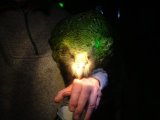 Far from being flighty, as soon as Sirocco realised he had an audience he walked straight up to the perpex and got as close as he could to his visitors. Even in the low light we could see him clearly, down to the whiskers round his face and his earholes – Kakapo have very good hearing. Unfortunately, the dim light made photographing our star for the evening very hard. I took over 200 pictures, but only a dozen or so are even worth working with. The running commentary from Don – a fountain of ornithological knowledge – was on a par with anything that David Attenborough could run off for the Beeb and without a script. Sirocco played to the crowd, and was even coaxed onto a “swing” to be weighed while Don fed him grapes from a jar.
Our visit lasted over half an hour, but seemed to be a fraction of that. I did hear a sound that I dearly hope many more people get a chance to experience – a Kakapo “skraak”-ing. Sirocco almost always does it for his visitors, and maybe in the future there will be enough of the birds that such a sound will be relatively commonplace.
We all thanked Don – it was truly an honour to meet someone who’s done so much worthwhile work – and were guided back to the boat which, as promised, was now sitting higher on the freshly-imported water. The conversation was active as we made our way back to Stewart Island, everyone seemingly on cloud nine after their experience. I think I may have “sold” a copy of Last Chance to See to one of our guides who’d “heard the name” Douglas Adams, but wasn’t sure where from. With any luck, she’ll be off to Dymocks the next time she gets to the mainland. T-shirts, beanies and pictures were available for sale, but I just didn’t have enough cash. What I do have are some pictures and the memories.
I’m not going to be twee and say that this was life-changing, but it was certainly eye-opening. I worked out a while ago how much this one trip for a 30-minute birdspot had cost me, but you know what? Who cares. I’d have paid twice as much to do it. Now, I know the people organising this make next to nothing from these trips. They’re doing this so that other people can be as lucky as they are and see one of these marvellous creatures, and also to raise awareness. I hope what I’m writing and what I’ve told everyone on my lead-up to this visit has done this.
 There are a gazillion endangered species on this planet. The Kakapo is just one of them, but thanks to the hard work of people like Don Merton and the Department of Conservation these disastrous trends can be reversed. Admittedly, the Kakapo has been a relatively easy one to deal with given some luck. There were spare islands to house them on, males and females were found and the New Zealand government seem to care more about their native environment than many others in the world. The Kakapo, as a result, has been fortunate.
Kakapo poaching doesn’t happen. Their feathers aren’t used in some bizarre medicine, though many years ago they were prized in some Maori clothing. They have no natural mammalian predators (the ones they suffered from were all imported by us), so removing those threats on unspoiled land was a relatively simple if long-term job.
Other animals aren’t so lucky. Rhino, tigers, lions and the like have a major problem in that their most dangerous predator is… us. 200 people working to rescue these creatures can have all their efforts undone by one greedy bastard with a gun. But still, good people give up their money, time and efforts to try and save them. Simply because they deserve to be saved. Our world would be a hugely less interesting and magical place were these amazing animals to disappear.
So now a little plea. Same as last year for those who know me. It’s September so it’s perhaps a little early for this but come December please do not send me a xmas card. I’ll still be travelling and I’ll have nowhere to put them. Instead, locate a shop or a person on the street or the relevant web page and donate a couple of quid to the World Wildlife Fund. Or Save the Rhino. Or the Dian Fossey Gorilla Fund. Or the Kakapo Recovery Program. Take your pick. Any of these charities or another one with similar aims. Just a couple of quid (or dollars or whatever). Help these people improve our planet, to give these animals a chance to spread and grow back to respectable and safe numbers.
I’m just happy I’ve seen a few of these creatures very close up recently. We’re running out of time faster than I like to think for many of them and if I can do anything at all to convince you to put your hand in your pocket – or even volunteer to work – then all the expense of travelling around and the time of writing this up is a small price.
Soapbox away again. 
 That’s K for koala and kangaroo, both of which I got to cuddle today. Once I’d bought some new sunglasses (I lost my other ones after rock climbing) and loading up with food and drinks from the supermarket (significantly cheaper than 7-11 and the like, which are actually dearer than London), I wandered off to get the bus on Adelaide Street.
 The bus finally appeared and whisked me through the 40-minute drive to the Lone Pine Koala Sanctuary. It’s $20 to get in, though backpackers get up to a 20% discount. As the name suggests, it’s mainly koala that you’ll find there, though they do also have many other Australian animals such as echidna, frilled lizards, dingo, kangaroos and so forth. There are various photo opportunities, and to get a piccy with a koala is another $15 upwards (depending on what gubbins you want – postcards, CDs etc). Like so many other things, though, I’m here and I probably won’t get another chance. So I coughed up my $15 and had my picture taken (and a couple more with my own camera).
 A nice Danish couple took my picture as I fed some kangaroos as well. They’re fluffier than you’d expect (the kangaroos, not the Danes) and very docile. They’re also near-silent as they hop along and can really creep up on you.
 Handy to know.


![Reblog this post [with Zemanta]](https://img.zemanta.com/reblog_e.png?x-id=371fc9e3-774b-4bad-85fc-9ee9782b377a)


