Hot in the hills and a visit to a longhouse

We didn’t need too early a rise as Daniel said he operated on “elastic time” (flexible) and we should be at his for around 9:30. Ish. So we had a leisurely breakfast then carried our bags to the Corner, after our hoteliers said they would have the same room waiting for us when we got back.

At Daniel’s, we juggled luggage around and filled daybags with waterproofs, bottled water and the like. The day was to involve looping back to Belaga so we didn’t need to worry about nightwear. We’d pick that up afterwards, and before heading to our hosts’ for the evening.

We had two guides – one a bearded guy with a huge grin and big machete, the other an older-looking chap who walked barefoot. The former was our primary guide, the latter our boat captain who would pick us up from the far end of our trek. The path we were taking was over a mountain (not a huge one) and onto a track used by the British to escape the Japanese in WWII.

A short boat ride up the river took us to a small village with several piles of ash. They’d had a serious fire very recently and lost three quarters of their housing. Through the village, the guide took us into the jungle. Then around in circles for ten minutes until he spotted the right trail.

It was a fairly uneventful if enjoyable hike. The canopy blocked a lot of the sun out, but it was still a very hot day and our guide made sure we stopped for water at regular intervals. It seems a lot of other people had done the same judging by the number of plastic bottles scattered around. So here’s a warning:

If you’re on a hike with me – anywhere: the wilds of Borneo or the chilly Lakes in Cumbria – and you chuck a plastic bottle, or a crisp packet wrapper, or whatever onto the ground I will make you eat it. Shove it back in your rucksack – it weighs less than it did when it was full.

It took us around three hours to get to where we met our second guide and lunch was cooked up for us. A healthy mix of rice, chicken (some seasoned, some plain), fish (ick), something “from bull” (very gristly – not sure what part of the bull it was from) and pineapple. We enjoyed the food then walked across a small beach to our boat.

Another small trip took us to a muddly landing site. Ten minutes or so of squelching through sucking muck and trying not to slip into creeks and we arrived at a small but secluded waterfall. Clothes were swapped for swimming togs and in we jumped/slipped/tenderly stepped. There were many small fish in there with us and it’s the first time I think I’ve had my toes munched on by one. Well, several, in fact. Gents, do ensure you’re not swimming au naturale as it could get very uncomfortable.

We cooled off in here for the best part of an hour before packing up and squelching back to the boat and sailing to Belaga. At Daniel’s we met up with some more incoming tourists, changed into slightly less smelly clothing, picked up some gifts and were driven to our accommodation for the night. The longhouse we visited was owned and populated by Kayan people. There are many different “tribes” inhabiting Sarawak of which the Kayan are just one. They have their own language, clothing, customs and so on. The clothing has become more of a tradition, and used for ceremonies and celebrations. Everyone we met was dressed in t-shirts and shorts.

The houses themselves are simple affairs, electricity provided by a generator and generally a whole family lives inside. The houses are like a terraced row back in the UK – many individual houses joined together. Small family units will be in each one, but everyone from end to end will be related by birth or marriage to everyone else. It does make for a very close-knit and friendly community.

Our hostess was Rini (I think I spelled that correctly) who spoke some English, though her sister next door was much more fluent and helped out a lot. She herself was hosting Chrystelle and Jean, though we spent most of the evening as a group of four outside chatting to the children and to the elders.

Ah, the children. Wide-eyed and shy except for one little monster called Cecelia who was constantly the centre of attention. Great fun! They loved the things we’d brought – colouring books, coloured pencils, exercise books and the like. The coloured pencils in particular were greated with huge smiles and a small scramble. I ended up being used as a pencil-holder as we tried to find out how many I could stick into my beard before they fell out. I think we peaked on five.

Dinner was lovely, and enough food for four – but it was only Anthony and I eating as the others were being fed by their host. We ate as much as we could so as not to apear rude (and because it was good!) then rejoined the crowd. The children had gone to bed (except Cecelia who had rules of her own, it seemed) and chewed the cud with the older folk – all of them women. I’d say the men were down the pub, but there aren’t any in Belaga!

Traditional head-dresses were brought out for us to wear; one old lady did a traditional dance to music blaring from a traditional Sony mobile phone/walkman/camera; the French couple decided to try some of the “tobacco” that was produced. One of our hosts mimed that it “makes your head go a little strange” and asked if she could send some to them. She was somewhat puzzled as to why the police on the border may not be too happy about it, but I think Anthony did a decent job of explaining!

Other “local” things were tried out. Chewing leaves, some very hard nut (I think betel, but I’m not sure) and then some men came in with a nest. The bees inside are very dangerous and apparently the sting can be fatal. These adults were plucked out (unconscious – I guess they’d been “smoked”) and held in a flame tail-first to destroy the sting and kill them. Obviously, we were thinking “honey”. Not “larvae”.

Hum.

It was gone midnight when we retired. Thin mattresses had been put down for us, and sheets provided. Enough for a night’s sleep. Our “room” was cavernous, taking up the entire upper floor, and the aircon consisted of permanently open windows at either end. Bats used it as a short cut. Really rather cool.

Reblog this post [with Zemanta]

Kapit to Belaga

We got up around 7:45 to pick up our permit for travel north of Kapit. It’s tight as the permit office is open from 8:00 and the boat to Belaga is at 9:00. It’s even more tight when you find out that the permit office has moved quite some distance out along the airport road.

There are signs posted on the old building, but these are faded from sunlight and actually seem to say “We Are Here” rather than “We Have Moved” so we couldn’t tell when we scouted the place the night before. A nice local informed us in the morning that it’s about a 30 minute walk to the new office, or we could get a van from the market. All fine if you’re planning on it, not so good if you reckon you have an hour to wake up, get your permits and hop on the boat.

So we didn’t bother. Checking a few websites, generally nobody asks for them anyway. And if they do, you tell them you arrived by road from Bintulu where you can’t obtain a permit. They’re only dished out in Kapit. The permits are free, so nobody’s losing out. As far as I can gather they’re more to stop logging protesters from gaining access to the jungle areas, so as long as you don’t look like a hippy or wear a Greenpeace t-shirt you should be fine.

A nice lady at the pier made sure we got on the right boat and we bought some frozen drinks from her. Mine was a vry authentic-tasting banana juice. Green and stored in a re-used water bottle. I have no idea what it’s made from and where the water originated, but I’m not dead yet so it must be OK.

The MR30 journey to Belaga was nearer four hours than three, but comfy enough and it’s a great experience to stand on the side of the boat or sit on the top as it whips through the water at around 60 mph (I don’t do nautical units, sorry). It’s a very different experience to the Mekong trip. The river’s much wider and there are fewer settlements on the riverbanks. Those I did see were impressive in length – they get the name “long house” for a reason.

On the boat we met a French couple and we’ve informally agreed to trek with them. It’s likely we’ll get a better price as a group. They’re also heading to Miri afterwards, so again we’re assured of being able to fill up a 4×4 for the bumpy journey in a couple of days’ time.

After a quick walk around town (and I mean quick – we walked every street in a little over 3 minutes) we located Daniel’s Corner which is recommended as being the best place to sort out a tour. Only it was closed, we assume opening in the later afternoon or evening. Right now, my stomach is wondering why it’s had nothing but banana juice all day so I’m off in search of a Big Mac.

(later)

No Big Mac, but egg noodle and… erm… something instead. It was meant to be chicken, but I swear it was fishy. I left those bits at the side of the plate and concentrated on the noodles. Belaga isn’t somewhere you want to be stuck if you’re not a fan of eating the local cuisine.

Anthony and I then took a stroll out of town and into the country for an hour or so, then circled back. There really isn’t a whole lot to do around here, though it’s a pleasant place. Slurping ice lollies we watched one of two football games going on between schoolchildren. A quick email check and we walked around the Daniel’s Corner to catch up with the French couple (Chrystelle and Jean, I think – I’ll correct those if I’ve got them wrong!)

Also there when we arrived was a German girl, Ellie, who speaks very good French and English, and acted as a translator for Chrystelle and Jean. Jean’s English is pretty good, but he had some trouble with Daniel’s accent so it all worked out pretty well.

Daniel tailored a trip to suit all of us, based on requests and ideas he had. While he made some phone calls to guides and houses, we skipped round the corner for dinner. Again, local fare, although Ellie bailed out as it was “too expensive” at MR5 per person. She went to find somewhere charging MR3. In exchange, we got to share a table with the town drunk who kept repeating himself over and over. Harmless enough, but it made conversation harder. We were also joined by Daniel’s deaf/mute (or whatever the politically correct term is this week) daughter. Or niece. I’m not sure which. She’s a giggle anyway – constantly in motion and miming away like a loon.

After our food, we walked all the way back along the street to Daniel’s where he revealed the pricing. Two days, one night for MR260; three days, 2 nights for MR300. Ellie balked and said she’d sort something else out, mainly as she’d already done trecking and needed new shoes before she could step foot in a jungle again. Anthony and I opted for the shorter option while the French contingent settled for the longer one.

Now, Lonely Planet (out of date, though it is) does say that Daniel does trips for MT180 for 3 days. Well, he does. Even accounting for inflation. But you’ll stay in one place for 3 days and take each excursion from there with a long night afterwards. He found that tourists found these boring, so changed plans to allow people to move around and see more things. Of course this means transportation costs, more guides and paying more families for the use of accommodation hence the price rise. It’s around £40 for 2 full days, meals, guides, transport. Other than buying gifts for hosts (a quid or so on some exercise books and pencils is very welcome) there’s no more need to put your hand in your pocket.

He also said he’d arrange our transport to the junction on the way to Miri for when we were finished, to save us ringing around. Job sorted, we walked back to the hotel. Ellie was in the room above us, and I spent a good couple of hours nattering to her. An interesting girl – she’s spent 3 years in India and 18 months in Thailand, amongst other things, and hitch-hiked to Belaga earlier today!

Reblog this post [with Zemanta]

Kuching to Kapit

First of all, apologies for any mistyping as the keyboard in this cybercafe is driving me nuts. A short post as a result, but I doubt I’ll be posting for another couple of days so wanted you all to know where I am!

I buddied up with Anthony from the hostel, which is saving a few bob on hotels and taxi fares. We got the boat from Kuching to Sibu (5 hours) and from there to Kapit (3 1/2 hours) where it’s tanking down. Tomorrow, we (hopefully) get another boat, this one to Belaga where we will sort out a trek for a couple of days. Obviously, this will mean no blog posts. I reckon there’ll be a cybercafe in Belaga but you never know.

Not much to add unless you’re travelling to Kapit. Don’t go by the town map in Lonely Planet when you arrive. Work is currently ongoing on a new wharf, and it’s due to be completed in mid-2009. If you travel up from Sibu, you’ll land at a temporary wharf. It’s located directly north (or vertically up the page) from the roundabout on the left. This will help you navigate and save you walking 5 minutes away from your hotel when you land, rather than towards it…

Reblog this post [with Zemanta]

Don’t call them monkeys

Somehow my internal alarm clock woke me at 7:30 after only a handful of hours asleep. When the girls (Christina and Nydia) arrived back the previous evening, we decided to go out for “a drink” at a nearby bar which doesn’t have a name. It’s decorated like a long house and owned by a local celebrity, Peter John.

Peter used to be a pub worker and a DJ before finding himself suddenly a pop star. Not bad for a lad who grew up in the jungle. He used the money he made to buy himself the bar and it had been recommended by our hosts. So, one drink, then back to watch a DVD.

As if.

Peter introduced himself and showed us a load of photos he’d taken at Uncle Chang’s on Mabul Island as he’d just come back. Then more photos of Bako. BY which time I was on my third and the girls on their second beers. More flowed as we were enjoying a good chat, then the girls managed to look pathetic and girly and got free rice wine shots from the bar tender. I’m not complaining as they got me one, too! I should wear a skirt and shave my legs more often.

By 3am, we were well sozzled and were chatting away with a bunch of locals. And got an invite to a party the next night. Thing is, my plan is to depart on the 8:30 boat on Sunday morning, so I’m either going to risk missing it, travel with a hangover, or have to stay an extra night.

I’ll worry about that later.

As I said, I miraculously rose at 7:30 and banged on the girls’ door as they wanted to go to Bako. I think I was hammering for almost a minute before I heard any response! I’d intended to wake at 7:00 so I had no time for breakfast, instead just grabbing everything I needed and running out the door to catch the 8:00 bus to Semenggoh.

This used to be a functioning wildlife rehabilitation centre, but now it’s just a reserve playing host to the animals that were reintroduced to the wild here. The area’s not actually big enough to support the number of orangutan, so they supplement their diet with feedings in the morning and afternoon.

To get there, you hop on a minibus outside the tourist office at 8:00 or 2:00. The journey’s around half an hour and it costs MR25 return, including park entry. All of this is given to the driver when you return to Kuching.

There isn’t really a lot to say about Semenggoh apart from that it’s small, pretty and chances are you will see some orangutan, but they can’t guarantee it. If it’s raining, don’t go as the orangutan don’t like to come out in the wet. The advantage is that if it rains in the morning, then you’ll likely see more of them for the afternoon feed should the weather clear up. The girls did this the day before and saw seven of the animals. I saw five including a baby, so Im not complaining!

They are magnificent animals. Despite their bulk and gangly looks, they move remarkably slowly and gracefully through the trees, traversing up and down the trunks effortlessly. To move around, they sit in one tree and wobble it until it bends close enough to the next for them to grab and swing over.

Contact with the animals is a strict no-no and generally there’s a warden around to make sure nobody gets within 5m when the animals are low down. At the end of the day they are wild animals and the adult males are more than capable of removing puny human limbs from their sockets if they feel in any danger.

There are also other animals loose in the area, but it’s highly unlikely they’ll be seen. Three crocodiles are penned up in cages towards the back of one of the feeding areas. I’ve no idea if the plan is to set them free or what. They just sit there looking very annoyed.

I talked to a Dutch guy in the bus both ways and it passed the journey time well. A bonus given that I should still have been asleep. Most people follow the same kind of trail north, so perhaps I’ll bump into him again in Kota Kinabalu.

The sun was baking, so I had a quick look at two of the mosques then walked back to the hostel to do a quick shirt-wash and type this lot up. And to check out the hundred or so photos I took of the apes. Oh, and I did find out where the name comes from. “Orang” simple means “person” and “hutan” means “forest” – so they’re “people of the forest”. Cool, eh?

Reblog this post [with Zemanta]

A walk around Kuching

Kuching’s not a big place. The main city centre area can be circled in maybe half an hour or forty minutes on foot if you don’t stop to look at things. It’s also worth checking when things are open or accessible as these times vary. In particular, the mosques will have times when they’re in use so unless you’re Muslim you can’t enter.

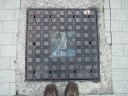
Before I begin, though, a brief history of Kuching. First bit of trivia is that “Kuching” is Malay for “cat” which explains some of the decor and statues. And the fact that there’s a cat museum a few kilometres from the north side of the river. And the statues. And the drain covers. The city was given the name by an English man – Charles Brooke – who’s uncle settled here in the early19th century after deciding he didn’t want to head home after being injured and sent packing while in Burma by the East India Company. So he decided to travel a bit, thanks to being fairly well off anyway, and also getting a decent pension.

Sir James Brooke landed in Sarawak (as Kuching used to be called – a name it shared with the region of Borneo in which it is situated) and helped the local viceroy quell an uprising. As a reward, the sultan of Brunei declared him raja of Sarawak. This was in 1842. Pretty cool, really.

For three generations, the Brookes ruled the area. From James to Charles (who renamed Kuching in 1872) to Charles Vyner Brooke. And then the Japanese arrived as part of their WWII plans at which point Charles V decided to take a hasty holiday in Sydney. The Japanese surrendered in 1945, but… and here I have heard two different versions of the story. In one, Charles V “decided” to cecede his rule of Sarawak to the British Crown. In the other, he was told in no uncertain terms by the royalty that he (or any of the Brooke’s family) wasn’t allowed anywhere near Sarawak any more, and was given £150,000 as a golden handshake.

Either way, on July 1 1946 Britain had another colony in its grasp. And then Anthony Brooke – next in line for the raja “hat” – jumped in and threw his weight behind an already-growing movemement which wanted to oust the British. Because bizarrely, despite what I gather was a harsh rule by the second Brooke, the Malaysians rather liked the way things were before the war.

Five years later, Anthony Brooke announced that the protests and fighting should end and withdrew his support. In 1957, Britain herself withdrew and Malaysia (or Malaya as it was then known) was made an independant nation. In 1963, after a lot of grumbling and political dummy-throwing, the Borneo area was included into Malaya and the Federation of Malaysia was formally recognised. Indonesia and the Philippines weren’t so happy, and Indonesia conducted border raids for some years to try and disrupt the new state. The Philippines just stuck to random acts of piracy which still (rarely) occur today in the far outlying islands.

Nowadays, Sarawak is a hugely diverse region. The population are a mix of people from Chinese, Malay, Indian and probably still some western backgrounds. Kuching is prime example, being like a very small Singapore. The same mix of nationalities with the same architectural styles and the same lack of animosity between them all.

The city has an Anglican cathedral, Islamic mosques, Hindu temples and Chinese temples. The food is similarly diverse and although there are areas which are more one culture than another, there’s a tremendous mish-mash even if you just walk in one long street. It does make for a very interesting visual experience.

It had rained a lot overnight and it was still torrential in early morning. By around 10:00 it had settled to a steady stream with could be contended with using one of the umbrellas kept handy in the hostel foyer – I loaned my folding umbrella to the two girls as they were heading to one of the parks and would need something smaller.

Passing the Heroes’ Monument I walked up to the Sarawak Museum. This is split into two buildings on either side of the main road and is open from 9:00 to 4:30 (not 5:30 as in Lonely Planet – it’s changed recently and the signs have been hand-altered) all week. Entry is free, though there’s a donation pot just inside the door. I checked out the old wing and it’s OK. A lot of stuffed animals and fish in various glass cases, some interesting information on geology and a Shell-sponsored exhibit about recovering oil and gas. Fact: Shell got its name as the company was originally an export business based here. One of its major exports was polished sea shells. Only later did their founder plunge his money into the new-fangled “oil” stuff.

Upstairs are some displays on various indiginous cultures with a replica set of rooms from a longhouse and miniature longhouses from several of the “tribes”. Pretty good stuff. Overall, it could do with a spring-clean and some morr lighting but it is informative and free.

Over the road, the new wing looked like it was between exhibits. A handful of pictures and a small model boat were all I could see, and the upstairs viewing gallery was closed. The new Natural History and Arts buildings seemed to be closed, but whether this is due to them not being complete yet, I don’t know. Also, for reference, the Islamic and Chinese museums are both closed on Fridays.

As the rain eased off, I walked up to the open market and some of the shopping streets. I picked up possibly the world least healthy chicken-and-beef burger. It was Halal so I have no doubt over the quality of the meat, but the sauces were ladled on and by the time I unwrapped it somewhere out of the rain, grease was oozing from the greaseproof paper it was wrapped in. Still, it was tasty and only RM2.70 (maybe 45p) for a double-burger with everything isn’t bad. A shame there were no napkins in the bag. I washed my face and hands using rainwater pouring from a nearby roof. When in Rome… (or Kuching).

My next stopoff was the tourist office to check boat and bus times for the next couple of days. The Lonely Planet I’m working from is the “Malaysia, Singapore and Brunei” one and I’ve already found some things out of date in it. It’s the current edition, but published in January 2007 so that’s to be expected. I don’t mind if I get somewhere and a guest house is a pound more than I’d planned, but missing a bus because of a schedule change could be disastrous.

While there I asked about cinemas and was shown two on a map and given the local paper to dig through for the schedules. I’d wanted to see Wall-E, but despite and August 7th release date in Malaysia, it’s not making it to Borneo until the 14th. Ah well, I’ll catch it in Kota Kinabalu.

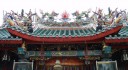
I had to skip the mosques as they don’t open for non-Muslims until 3pm on a Friday, so I wandered through one of the more Chinese areas (Carpenter Street) and hd a quick look at the beautiful Sang Ti Miao and Hong San temples. The Tua Pek Kong temple a little further over could be the oldest standing building in Kuching, although the Bishop’s residence (now within the cathedral grounds) is “officially” the oldest. The temple is mentioned in texts pre-dating the residence, but the latter has formal paperwork detailing its construction. I’m going for the temple because it’s prettier and I’m not a church-goer.

There’s a bizarrely-painted car park down the street from the Tua Pek Kong temple – each floor is a different garish pastel colour – and this houses the Star City cinema on the 9th floor. The lower ground is meant to be a food court and the upper ground a mall, but they’re both closed. Everything else is parking. I took the lift up to the cinema and thought I’d entered a film as the staff all seemed to be keeled over. The woman collecting the 20s for the toilet, the concession counter worker… Only they weren’t dead, just asleep.

I checked the times and prices (and languages). Sadly, Red Fort is only available in Chinese with no subtitles. In Bangkok it had Thai subtitles so I was hoping here they may have English. Ah well. Shaolin Girl looked entertaining as it’s by the same director as Shaolin Soccer and Kung Fu Hustle. Chinese with English subtitles, RM8 per ticket… and I couldn’t see it as I was the only customer. They need at least two to show a film. Tempted as I was to pay for two tickets, I decided to wait till later and see if the girls at the hostel fancied it.

Despite checking every other mall in the area, I couldn’t find the other cinema. Never mind.

I managed to locate the bar which is designed like a long house, but it was shut (most bars open at 6pm) so I’ll save that one for later. I hear the food is good and cooked in a traditional manner. A block or two away is Picaddily’s, a bar run by an ex-guest of the hostel I’m staying at.

After a quick email check (OK, an hour online but it was only 50p) I got back to the hostel for some munchies and a shower. The place is deserted and it’s like staying at a friend’s only they’ve given you the key! I hope the girls didn’t get rained on too much and I’ll catch them later.

Tomorrow – orang-utan and mosques. And perhaps I’ll find out where orang-utan get their name from. I’ve seen “orang” in a lot of signs in Malay – I think it means “adult” or “senior” or maybe just “big”. Must remember not to call them “monkeys”.

Zemanta Pixie